Alishan Travel Guide 2026: Top Hidden Gems, Flower Season Dates & Transportation Costs All in One!

- What can you do in Alishan? Which attractions are most worth visiting?
- Special recommendation: 3 hidden gems in Alishan for a different side of the region
- What’s the best month to visit Alishan? How do the seasons differ?
- What’s the most convenient way to get to Alishan? How much does it cost?
- How do you take Taiwan Tourist Shuttle 7322? What’s the timetable?
- Is a private car to Alishan expensive? Is it worth it?
- How do you get Alishan little train tickets? Can you still see the sunrise if you don’t get one?
- What time should you get to Zhushan Observation Deck for sunrise? Where’s the best viewing spot?
- Can you do Alishan as a day trip? What itinerary would you recommend?
- What trails are there in Alishan? How difficult are they, and who are they suitable for?
- What should you keep in mind when visiting Alishan with seniors or children?
- Bonus: When does the 2026 Alishan cherry blossom season begin?
- Are there traffic restrictions during blossom season? On which dates, and at what times?
- How much are tickets for Alishan attractions?
- Frequently asked questions about Alishan attractions
- tripool editor’s honest take: this is the best way to do Alishan
If you're planning a trip to Alishan but have ended up even more confused after reading dozens of travel guides, this article is for you.
What’s the best time of year to go? Is a day trip enough? Do you need to scramble for tickets for the little train? During cherry blossom season, are there traffic restrictions if you drive up the mountain?
These really are some of the most frequently asked questions online, because Alishan is not the kind of place where you can just buy a ticket, wander around, and call it a day.
Its attractions are spread out along Provincial Highway 18, from downtown Chiayi to the National Forest Recreation Area. Along the way, there’s also Shizhuo, Fenqihu, and Danaiku, and each stop offers a completely different experience. You also need to factor travel time between locations into your itinerary.
We have visited several times. The first time, we genuinely thought a quick round trip in one day would be more than enough. Only after coming back did we realize we had missed a lot of the places on our list.
That’s exactly why this fully updated 2026 alishan national scenic area attractions guide brings together all the lessons learned the hard way. It also clearly covers cherry blossom season dates, traffic control hours, transportation cost comparisons, and trail difficulty levels, so you can get a full picture of Alishan’s mountains, forests, and scenery in one go.

📌 Key Takeaways Before Trip (Quick Overview)
- Adult admission to the Alishan National Forest Recreation Area is NT$300 (NT$200 for Taiwanese nationals).
- 2026 cherry blossom season: March 10 to April 10, with the iconic Yoshino cherry blossoms expected to peak in mid-March.
- During designated blossom season control dates, traffic restrictions will be in place for the Alishan National Forest Recreation Area (Provincial Highway 18, 66K–88.2K, daily 06:00–11:00): 3/14–15, 3/21–22, 3/28–29, and 4/3–6, private cars are not allowed through, except for guests with proof of accommodation.
- Shuttle transfer service: 61K to Alishan, first departure 06:20, last departure 11:00; Alishan to 61K, first departure 12:00, last departure 16:30.
What can you do in Alishan? Which attractions are most worth visiting?
The fun in Alishan is mainly concentrated in two areas: the Alishan National Forest Recreation Area (one admission ticket covers Sister Ponds, the giant sacred trees, and Zhushan sunrise viewing), and the stretch along Provincial Highway 18 (Shizhuo, Fenqihu, and Danaiku are separate destinations, and some require additional admission).
Here is the must-visit list of alishan taiwan attractions for 2026:
Zhushan Observation Deck (for sunrise)
Source: roundTAIWANround
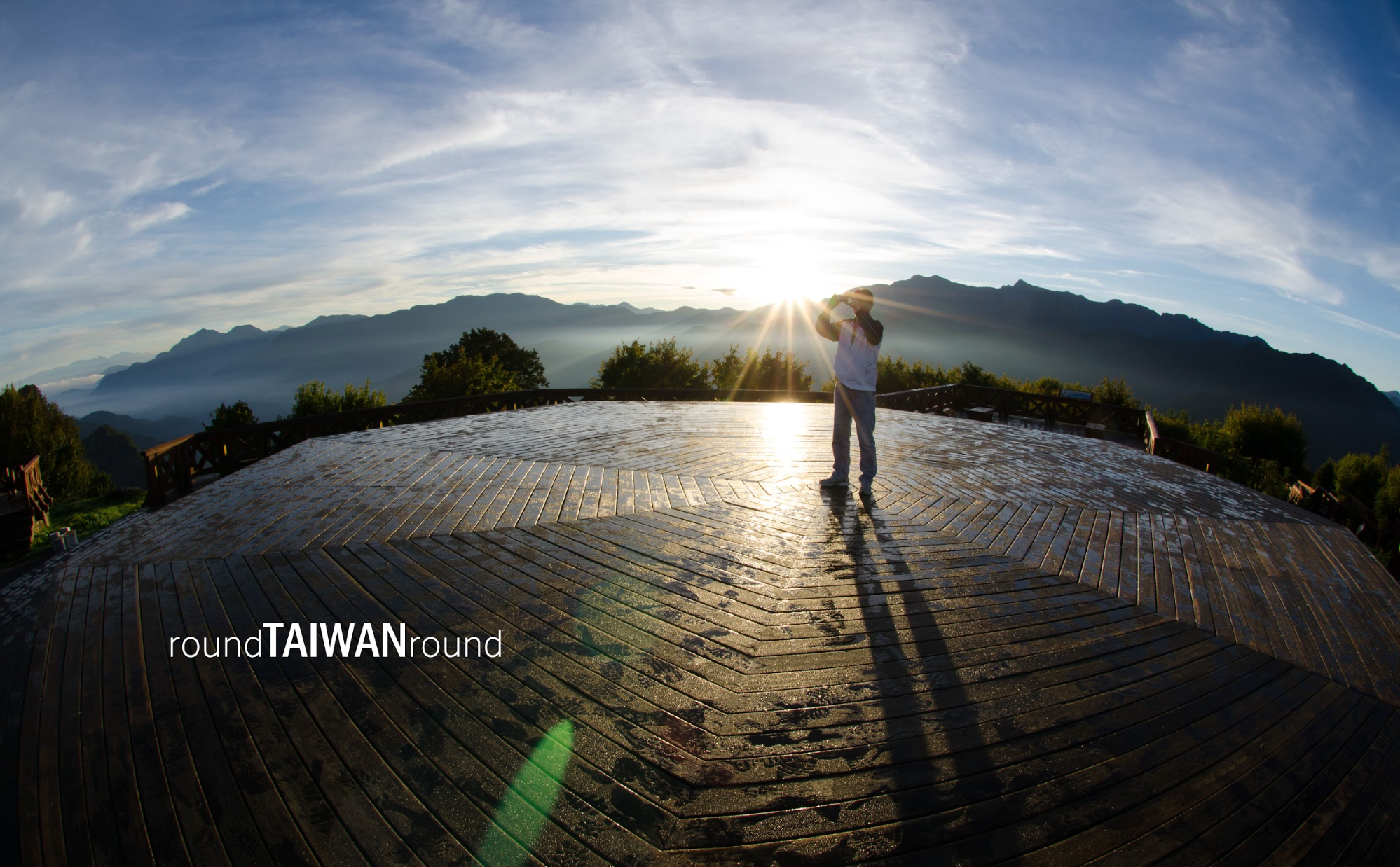
If there’s any place in Taiwan worth setting your alarm for 4 a.m., it’s probably this one. At an elevation of 2,489 meters, Zhushan is Alishan’s most famous sunrise spot. Here, you can watch the sea of clouds rolling beneath your feet as the first golden light breaks over the mountain ridge. The impact of that moment is something no photo, no matter how high the resolution, can truly capture.
That said, let’s be honest: for many people, the most unforgettable part afterward isn’t the sunrise itself, but how freezing cold it was. The mountain is high and windy, and even in summer, temperatures before dawn can drop to just 10–15°C. If you head up with only a light jacket, chances are all your attention will go toward shivering rather than taking in the view, so warm clothing is absolutely essential.
There are two ways to get up there:
- Take the “Zhushan Sunrise Train” (from Alishan Station; advance booking required).
- Hike up via the Zhushan Sunrise Trail (about 1 hour; bring a flashlight).
👉🏻 Strong editor’s recommendation: don’t rush back down right after sunrise. If you walk another 15 minutes, you can reach the Xiaoliyuanshan Observation Deck (2,488 meters above sea level), where you’ll get a 360-degree panoramic view and a chance to look out toward the Yushan mountain range. It’s the most unexpected highlight of the whole trip.
📌 Tickets for the sunrise train sell out extremely fast during peak season. It’s best to book 3–7 days in advance on the Alishan Forest Railway official website. Trying to buy on the spot often ends in disappointment, so don’t leave it to luck.
Sister Ponds
Source: roundTAIWANround
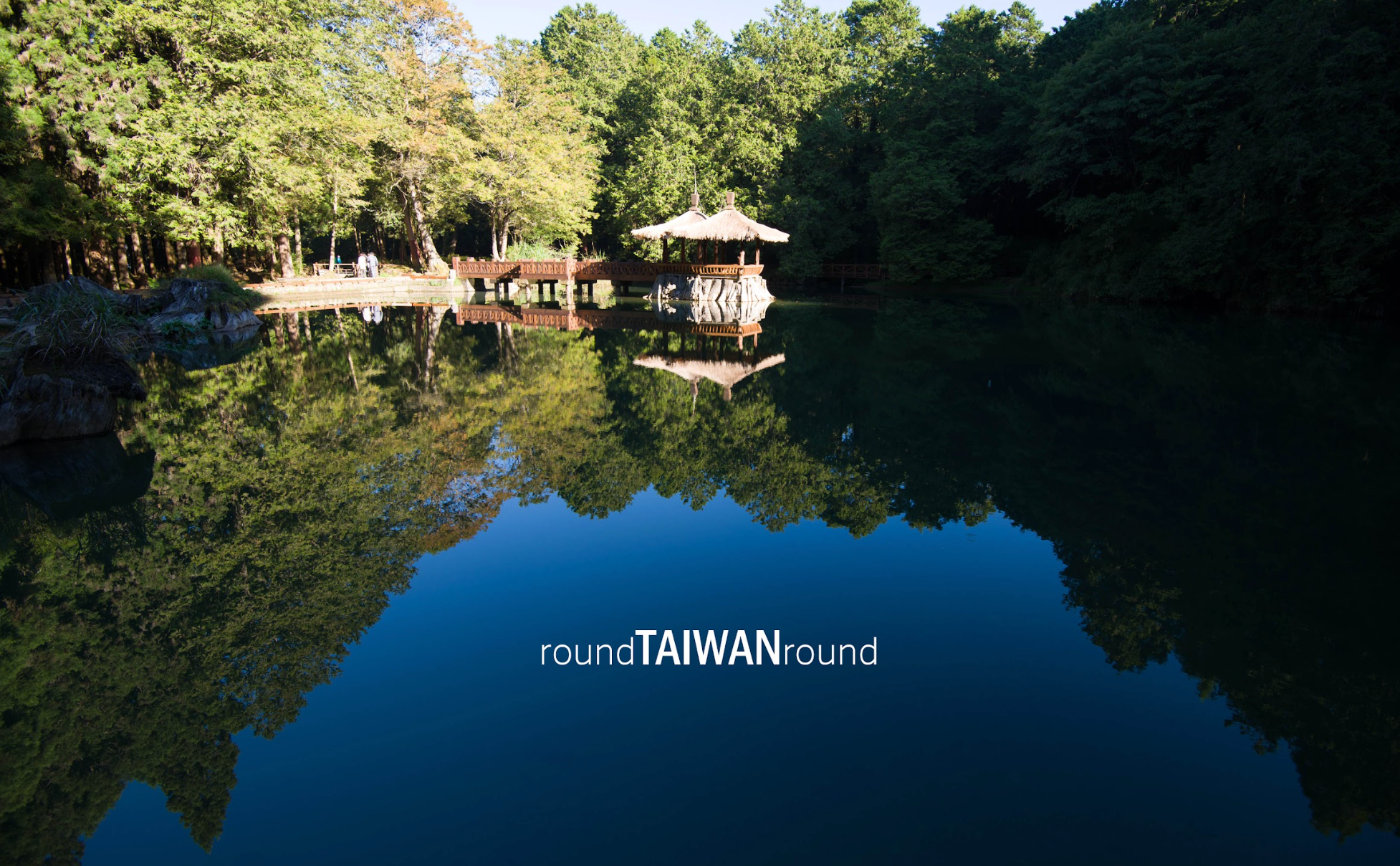
As you walk into Alishan’s forest trails, you’ll catch sight of shimmering water through the trees. That’s Sister Ponds.
The site consists of two neighboring lakes of different sizes, linked by a wooden suspension bridge. Their surfaces reflect century-old Taiwan red cypress trees and drifting mist, and even on an ordinary weekday, the setting feels like stumbling into a hidden paradise.
There’s also a poignant Tsou legend behind the site. According to the story, two close Tsou sisters both fell in love with the same man. Unwilling to hurt each other or give up their love, they ultimately threw themselves into the Elder Sister Pond and Younger Sister Pond. Sister Ponds thus became the sisters’ final resting place, and the story adds a haunting layer of melancholy to a landscape that is already beautiful enough to make visitors linger.
For that reason, Sister Ponds has become one of Alishan’s most popular spots for couples. The walking path around the ponds is easy and accessible, making it a comfortable option for both seniors and children. If you want the best photos, try to arrive before 10 a.m., when the angle of the light hits the water just right. Later in the afternoon, with more crowds and less favorable lighting, the results really are very different.
📌 Quick tip: weekends can get crowded, and the suspension bridge often backs up with people. Going on a weekday, or checking expected visitor flow before you go, can make for a much more peaceful visit.
Sacred Tree Area and Giant Tree Boardwalk
Source: roundTAIWANround
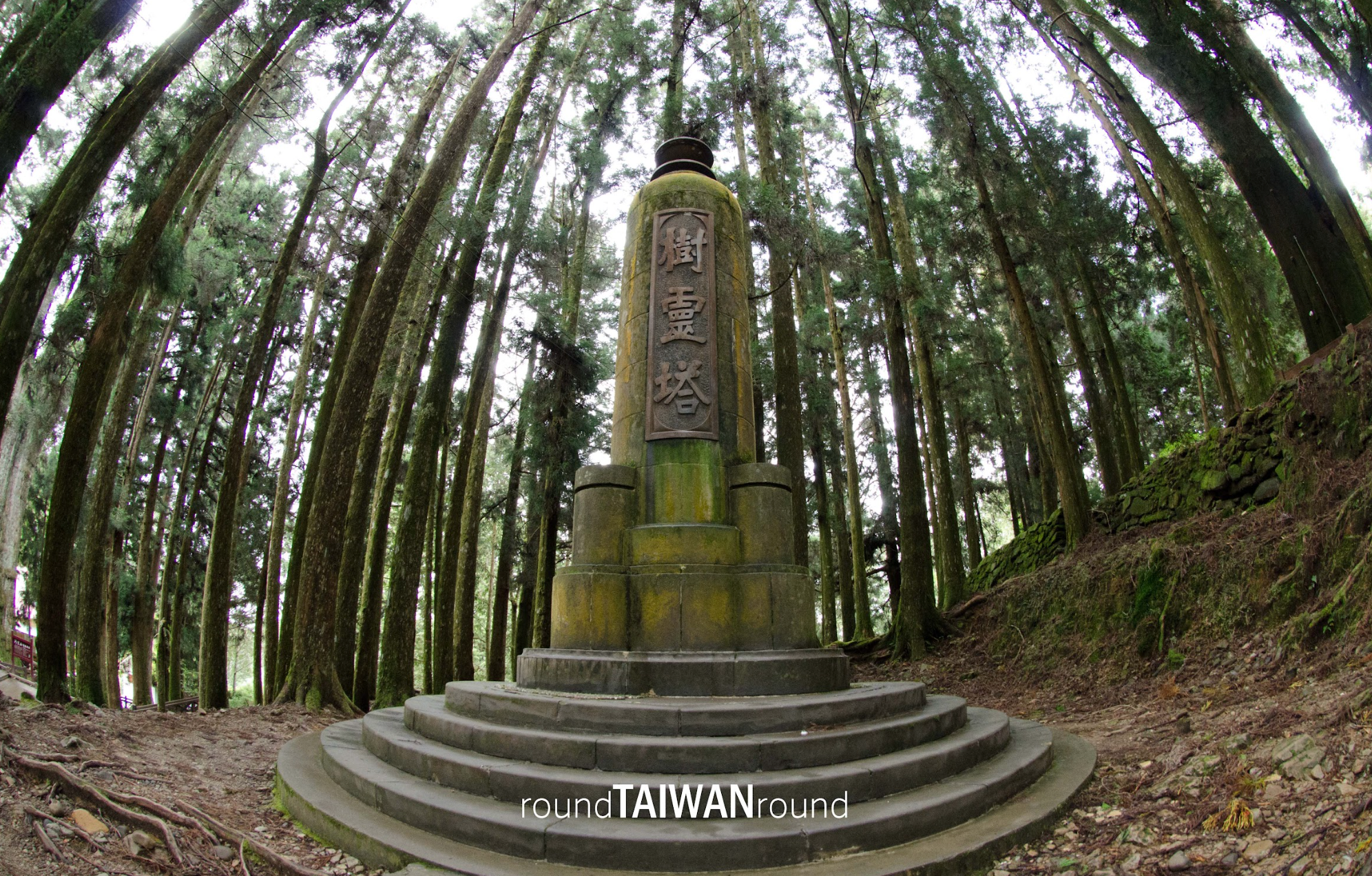
Alishan is famous across Taiwan for its “sacred trees.” After the 3,000-year-old Sacred Tree toppled in 1997, the park redesigned the area into the Giant Tree Boardwalk, allowing visitors to walk right past rows of massive Taiwan red cypress trees that are over a thousand years old. The base of each trunk is several arm spans wide.
Walking along the elevated boardwalk, with these towering giants silently surrounding you, gives you a sense of how small you are that’s hard to describe. For those of us used to city life, this is exactly the kind of place that reminds you why getting out into nature matters. Beyond breathing in the phytoncides, it’s simply a deeply relaxing experience.
The full Giant Tree Boardwalk route is about 2.1 kilometers long. The path is smooth and easy to walk, and at a leisurely pace, it usually takes about 1 to 1.5 hours to complete. We also recommend going early in the morning, before the mist has fully lifted. When shafts of light filter through the fog and forest, the giant trees look their most magical, far more atmospheric than they do under a bright, clear sky. There are also multilingual information signs along the trail, and each tree has a story worth pausing to read, so don’t rush through it.
Alishan Forest Railway (the little train)
Source: roundTAIWANround
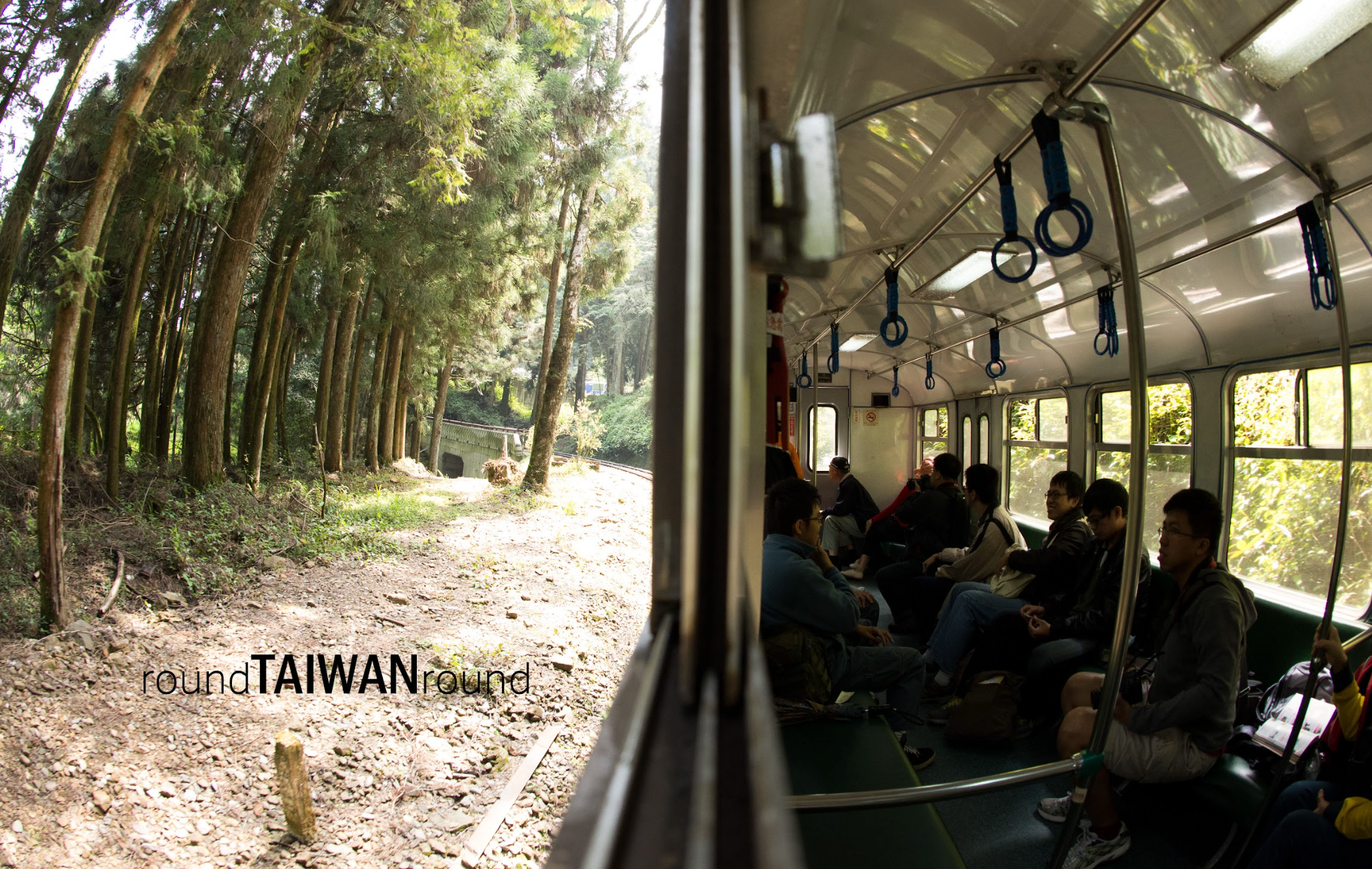
People who’ve ridden the Alishan Forest Railway almost always come away with the same thought: “The little train was even better than I expected.”
Built in 1914, the Alishan Forest Railway is the only high-mountain narrow-gauge railway in Taiwan still in operation. Its main line starts from Beimen Station in Chiayi City and climbs through tropical, subtropical, and temperate forest zones all the way to Alishan Station at an elevation of 2,216 meters. Along the way, the line loops through mountains, passes through tunnels, and crosses bridges over valleys, every section is a railway marvel that’s rare to see in Taiwan.
The windows on the journey feel like a moving frame for nature, and the scenery changes with every season: blossoms in spring, deep green in summer, golden tones in autumn, and mist in winter. There’s almost always a reason to ride it again.
👉🏻 The main line from Chiayi to Alishan takes about 3 hours, and it’s best to grab a window seat. The Zhushan branch line (Alishan → Zhushan) is ideal for sunrise viewing in the early morning. If you’re up for it, another great option is to ride up and walk down, enjoying the forest trails at a relaxed pace. For detailed train schedules and ticketing information, see: The Complete 2026 Guide to the Alishan Little Train.
Fenqihu Old Street

Source: roundTAIWANround
Often nicknamed the “mini Jiufen of southern Taiwan,” Fenqihu is best remembered by many not for its old street architecture, but for one thing: that unforgettable experience of eating a hot railway lunch box in the mountains.
Located on a mountainside at about 1,400 meters above sea level, Fenqihu was once a mid-route supply station on the Alishan Forest Railway. During its heyday, travelers would stop here specifically to buy lunch boxes, and that tradition has continued to this day, turning Fenqihu into the most iconic mountain railway bento destination in Taiwan.
Fenqihu Old Street itself isn’t very long, it only takes about 20 to 30 minutes to walk through, but the food options are surprisingly plentiful: hinoki cypress donuts, freshly fried taro balls, handmade mugwort rice cakes, aiyu jelly, and of course the classic railway bento with a chicken leg served in a metal lunch tin. Just seeing one being carried out is enough to make you hungry.
👉🏻 The most recommended way to experience it: take the Alishan Forest Railway to Fenqihu Station, buy a lunch box, and sit on the wooden benches by the platform to eat. The sound of the train stopping, mixed with the scent of the mountain forest, is what Fenqihu is really all about. If you’re driving, parking can be difficult on weekends. Also, railway bentos often sell out early on busy days, so if you want one, it’s best to buy before 11 a.m.
Danaiku Nature Ecological Park
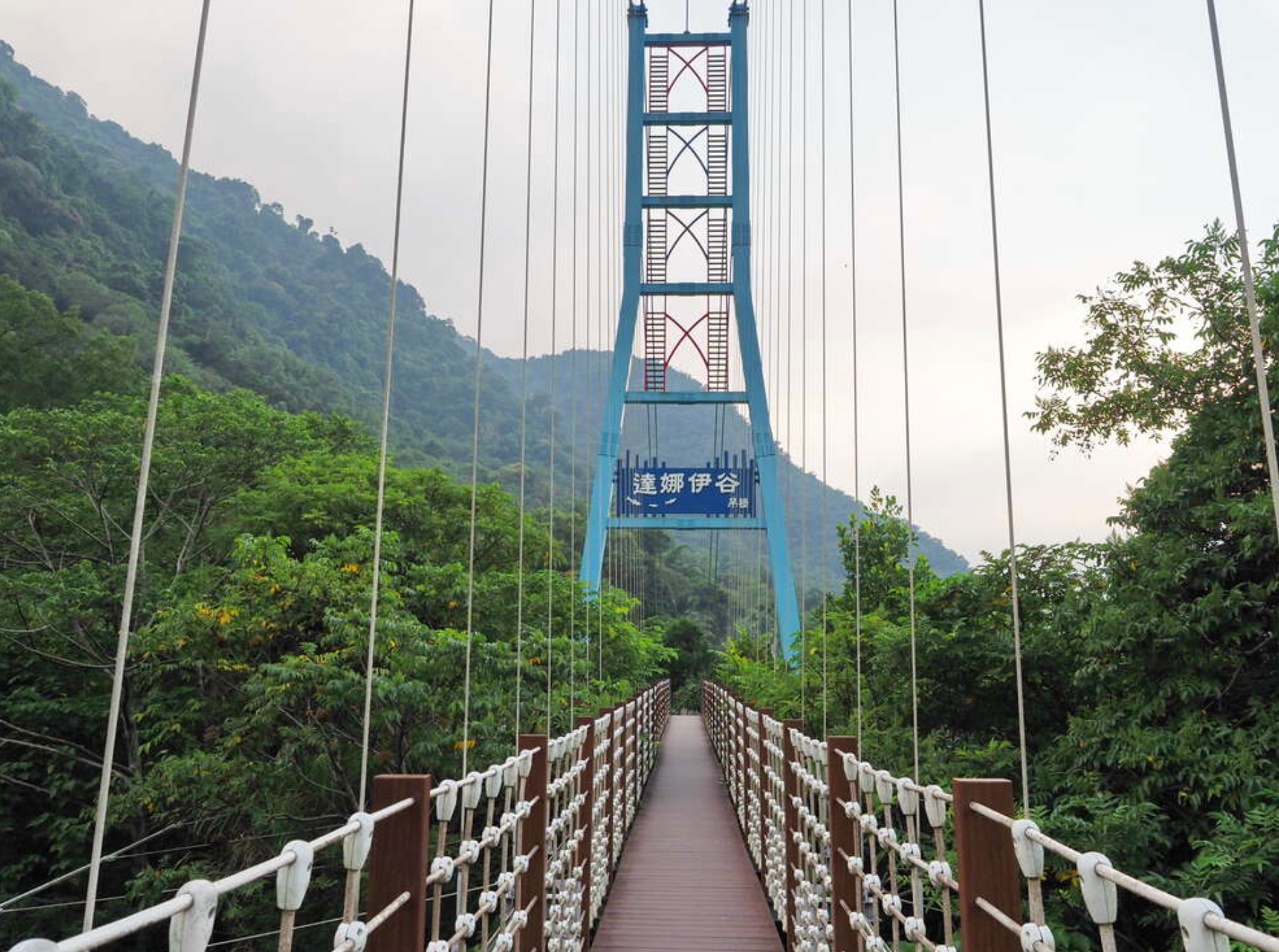
Image source: Alishan National Scenic Area Administration
If you were to ask where in Taiwan ecological conservation has been carried out in the most moving way, Danaiku would honestly be one of the best possible answers.
Located in Shanmei Village, Alishan Township, Chiayi County, Danaiku is also known as a sacred mountain of the Tsou people. Since 1995, the Tsou community has led its own fish restoration project here, reviving a stream that had once been heavily overfished and nearly dried up into one that is now crystal clear and full of fish again.
Stand by the stream and look down, and you’ll see many silver fish gliding through the transparent water. It’s a completely different level of awe from anything you’d see in a city aquarium, and what makes it more powerful is knowing that the Tsou people restored this scene fish by fish, with their own hands.
The park currently features a suspension bridge and a creekside trail. The full route takes about 1 to 1.5 hours, with mostly flat terrain that is manageable for both seniors and children. There are also occasional Tsou cultural performances, so it’s worth calling ahead before your trip to see whether any events are scheduled, you might be able to watch fish and enjoy music and dance all in one visit.
📌 Quick tip: the rocks along the creekside trail can be slippery, so wear shoes with good grip. Walking in with flip-flops really does increase the risk of slipping and getting hurt.
⏰ Opening hours: 08:00–17:00 (closed every Wednesday)
📍 Address: No. 51, Neighborhood 3, Shanmei Village, Alishan Township, Chiayi County
💰 Admission: NT$150 full fare
Eryanping Trail
Source: roundTAIWANround
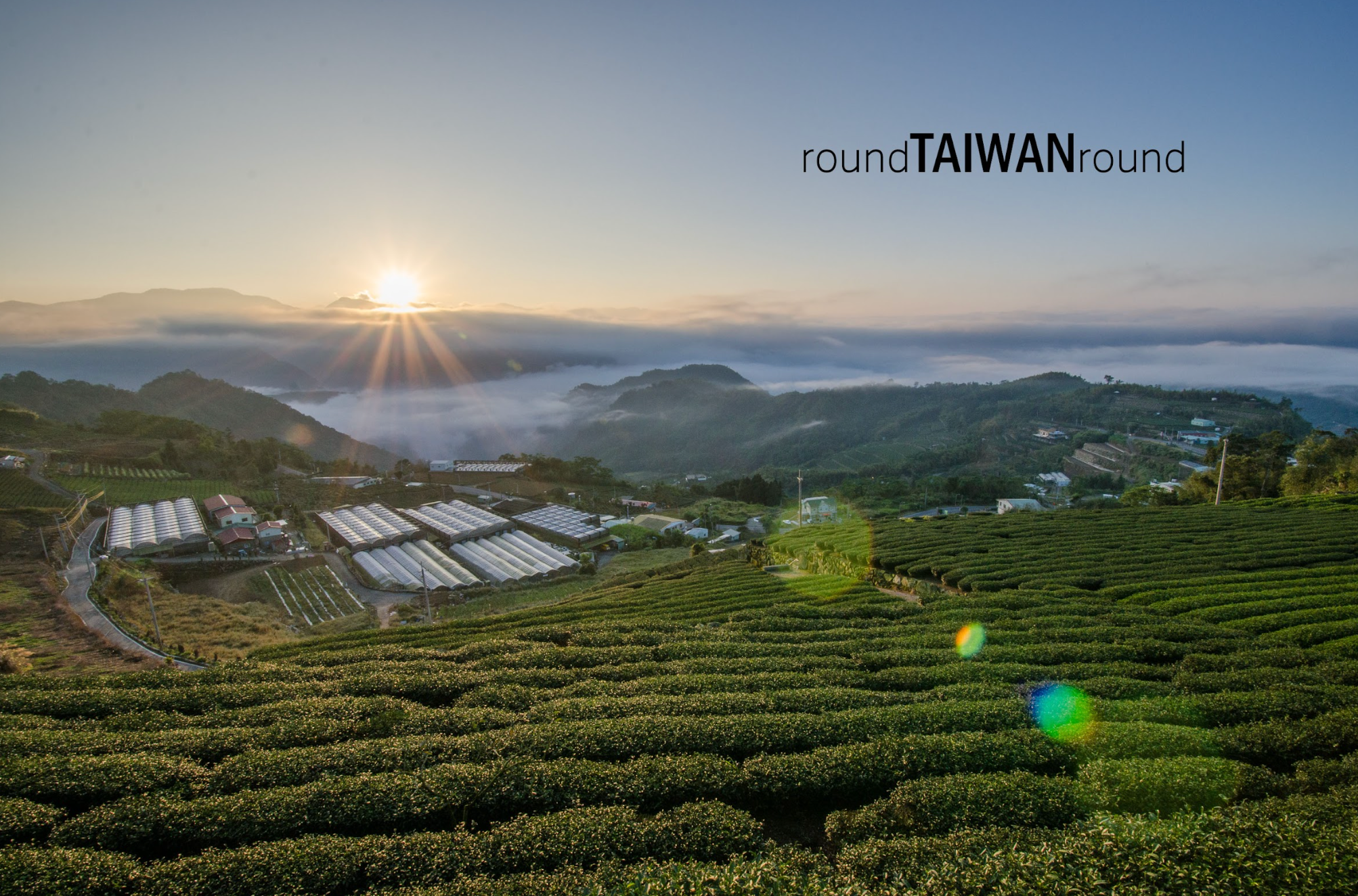
A 1.5-kilometer walk to a sea of clouds sounds like advertising copy, but at Eryanping Trail, it’s the truth.
The trail is located near Shizhuo in Fanlu Township, Chiayi County, at about 1,400 meters above sea level. Because the path is well maintained and the elevation gain is gentle, it’s manageable for most people, making it one of the easiest and highest-value beginner-friendly trails in the alishan attractions taiwan area.
When the weather conditions line up, the entire valley fills with a blanket of white clouds. They drift slowly through the ravines, gathering and dispersing in ways that feel almost surreal. If you’re lucky, you may even catch the so-called “glazed light” effect, when light refracts through clouds and mist to create dreamlike beams across the landscape. Honestly, it can look almost too beautiful to be real.
📌 Quick tip: the trail has wide-open views, but it also gets windy. Temperatures drop quickly after sunset, so bringing a warm windproof jacket is a smart move.
Shizhuo Trail Network (Xiding Sea of Clouds Viewing Platform)
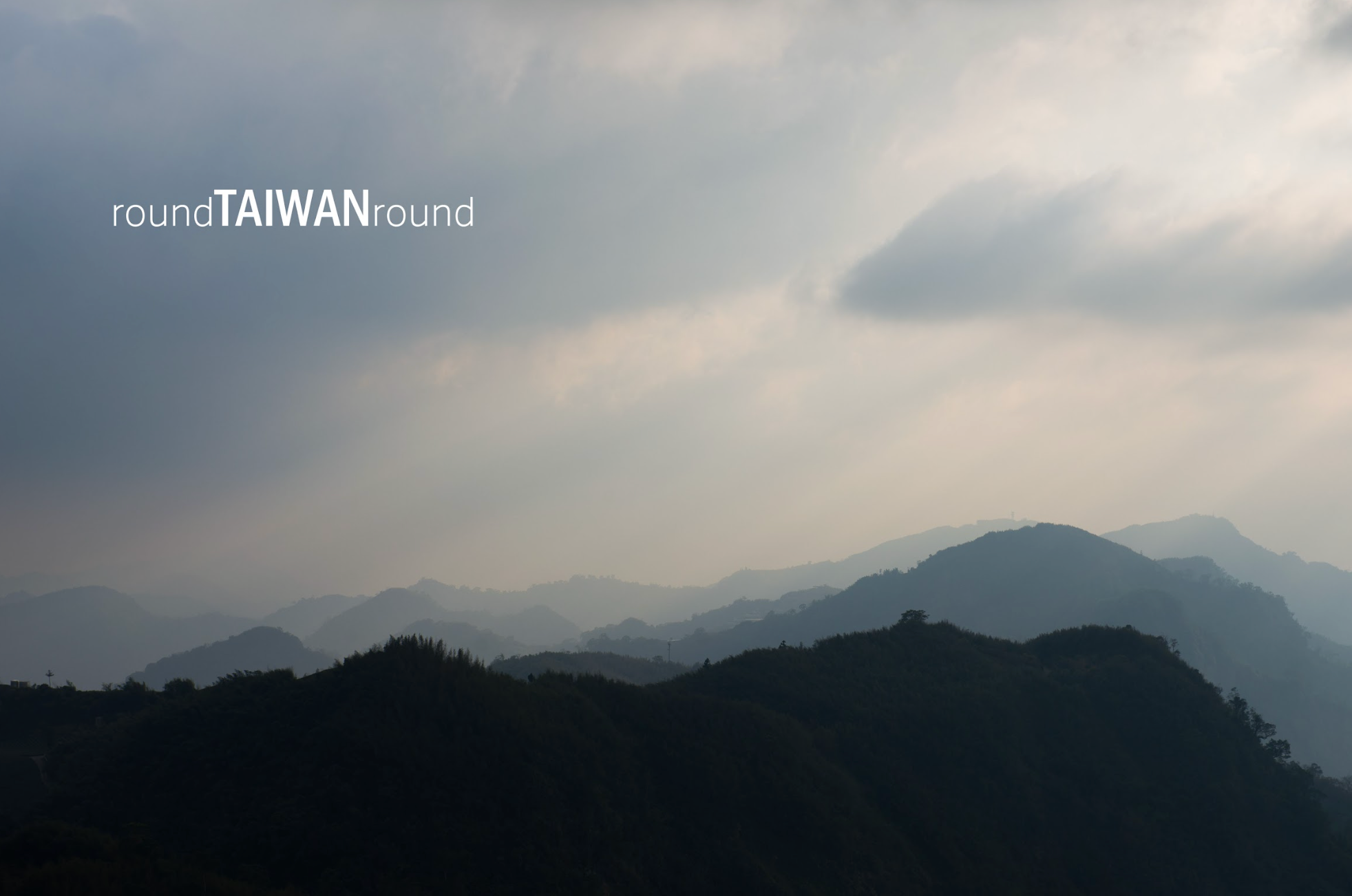
Source: roundTAIWANround
If Zhushan exists for sunrise, then Xiding exists for the sea of clouds. The sea of clouds in the Shizhuo–Xiding area is considered one of Alishan’s three great natural wonders, and contrary to what many people assume, it appears quite frequently here. As long as weather conditions are right, the entire valley can fill with white cloud in the late afternoon, creating a spectacle every bit as dramatic as views from Taiwan’s more famous mountains.
The Shizhuo trail network includes several routes of varying difficulty. The “Eryanping Trail” we just mentioned is the most beginner-friendly (about 1.58 kilometers total, flat and easy to walk), while the “Chalinshan Trail” passes through tea plantations and bamboo groves, making for a particularly soothing landscape. “Longding Viewing Platform,” meanwhile, is one of the best high points for chasing the sea of clouds, with an expansive view that makes you want to stay until dark.
👉🏻 If your goal is to catch the sea of clouds, the golden window is from 14:00 to 18:00, with the highest success rate in autumn and winter. But if you’re hoping for sunrise photos, staying overnight in Shizhuo is also worth considering. That way, you can head out directly the next morning without needing to enter the Alishan National Forest Recreation Area, and parking is much easier too.
📌 Quick tip: this area is especially good for self-drive travelers. Parking is convenient, and the crowds are much lighter than inside the recreation area. If you want a quieter, more relaxed cloud-chasing experience, this is often more comfortable than squeezing into central Alishan.
Special recommendation: 3 hidden gems in Alishan for a different side of the region
1. Mianyue Line
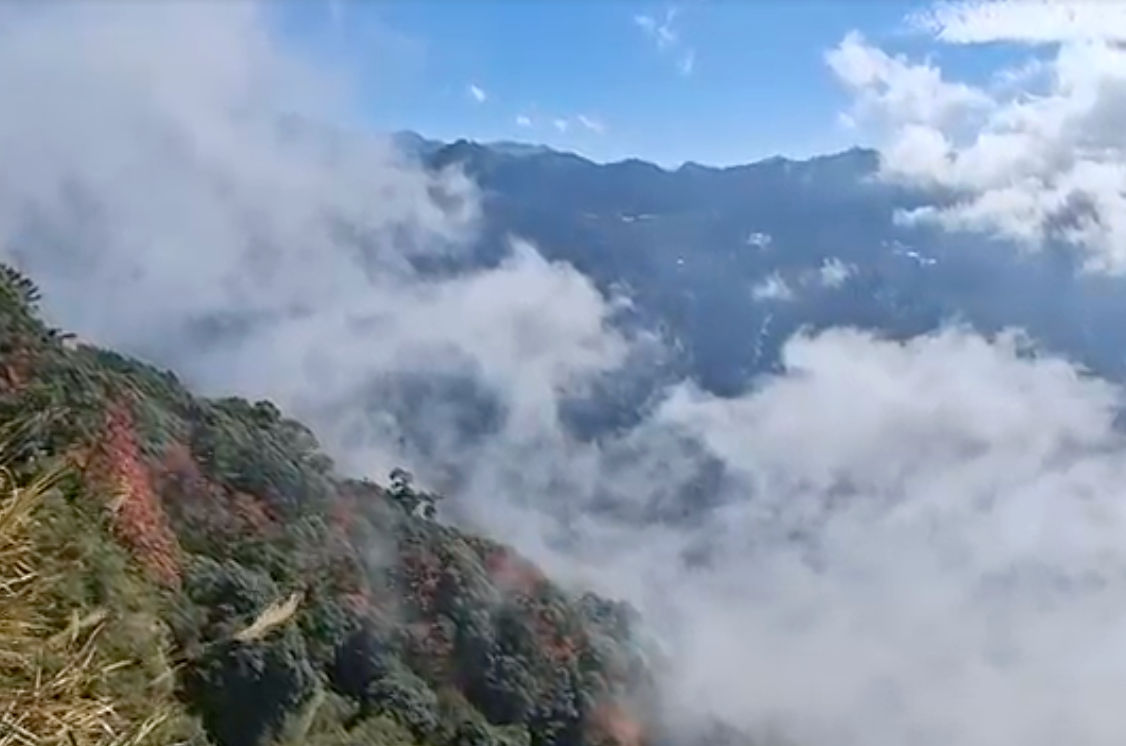
This is the kind of route only people who have already “done Alishan once” come back for. The Mianyue Line was originally a forest railway branch opened during the Japanese colonial period in 1921. It stretches 9.2 kilometers, passing through 12 tunnels and over 24 bridges. After being severely damaged in the 1999 Jiji earthquake, it became part of a protected natural reserve. To enter, you must apply in advance through the Natural Protected Area Entry Permit System. Same-day entry is not allowed. You need to apply for a park permit 5 to 60 days before your trip. If you enter the Mianyue Line without permission, you may be fined NT$10,000 to NT$50,000, definitely not something your wallet will appreciate.
Walking along the abandoned railway, you’ll see sleepers slowly being reclaimed by ferns and moss, while the rails fade in and out among the trees. Each tunnel is swallowed in complete darkness, and only when you shine your flashlight ahead do you catch that distant point of light at the other end. It’s an immersive, almost cinematic feeling that’s hard to match at ordinary scenic viewpoints.
👉🏻 The Mianyue Line is about 18.4 kilometers round trip and takes roughly 6–8 hours on foot. It requires a decent level of stamina, so it’s best suited to people with hiking experience.
2. Tefuye Historic Trail
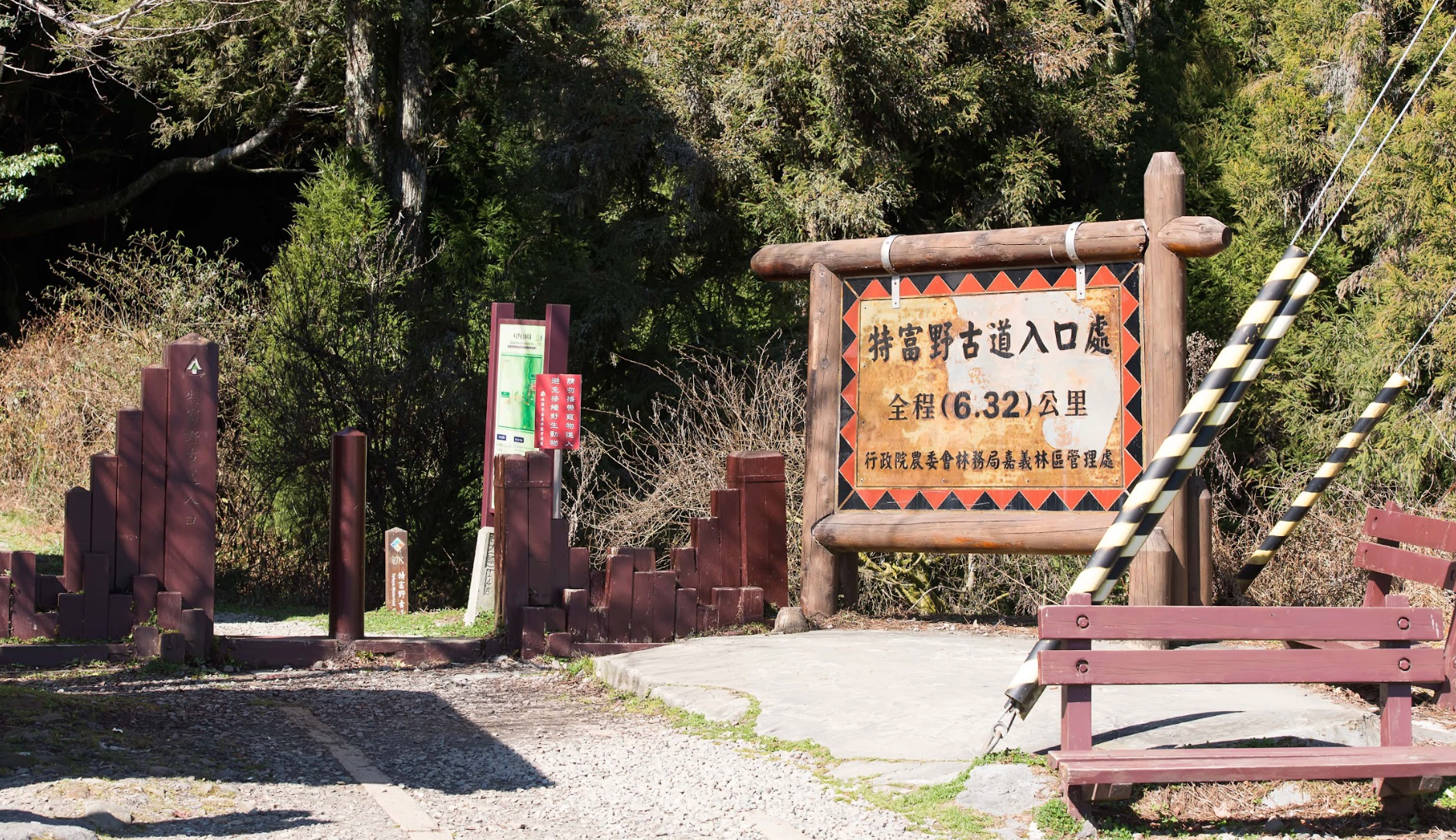
One of the few routes in the Alishan area where you can walk through truly untouched mountain forest and see almost no tourists the entire way is the Tefuye Historic Trail. Formerly known as Shuishan Historic Trail, it runs 6.32 kilometers in total. It was once a mountain path used by Tsou hunters traveling to and from their hunting grounds, and also served as a route for visiting relatives and intermarrying between villages. Every turn in the trail carries centuries of mountain memory.
The trail crosses forest between elevations of 2,000 and 2,600 meters, with conifer stands, hemlock, and beech forest appearing one after another. The fresh forest air makes you want to take a deep breath with every step. Most of the way, all you hear is birdsong and your own footsteps, it’s definitely not the crowded version of Alishan.
📌 Quick tip: it’s best to start from the Zizhong trailhead, where the first section is gentler and the slope increases only slightly once you enter deeper forest. One way takes about 3–4 hours, which is manageable for people with moderate fitness. However, if it has rained recently, the trail can get muddy, so waterproof hiking shoes are strongly recommended. If you enter from Dabang via the Tefuye south entrance, the access road is in poorer condition. In that case, a vehicle with higher ground clearance or four-wheel drive is recommended, and you should always pay close attention to road and vehicle conditions to stay safe.
3. Duigaoyue Sunrise Platform
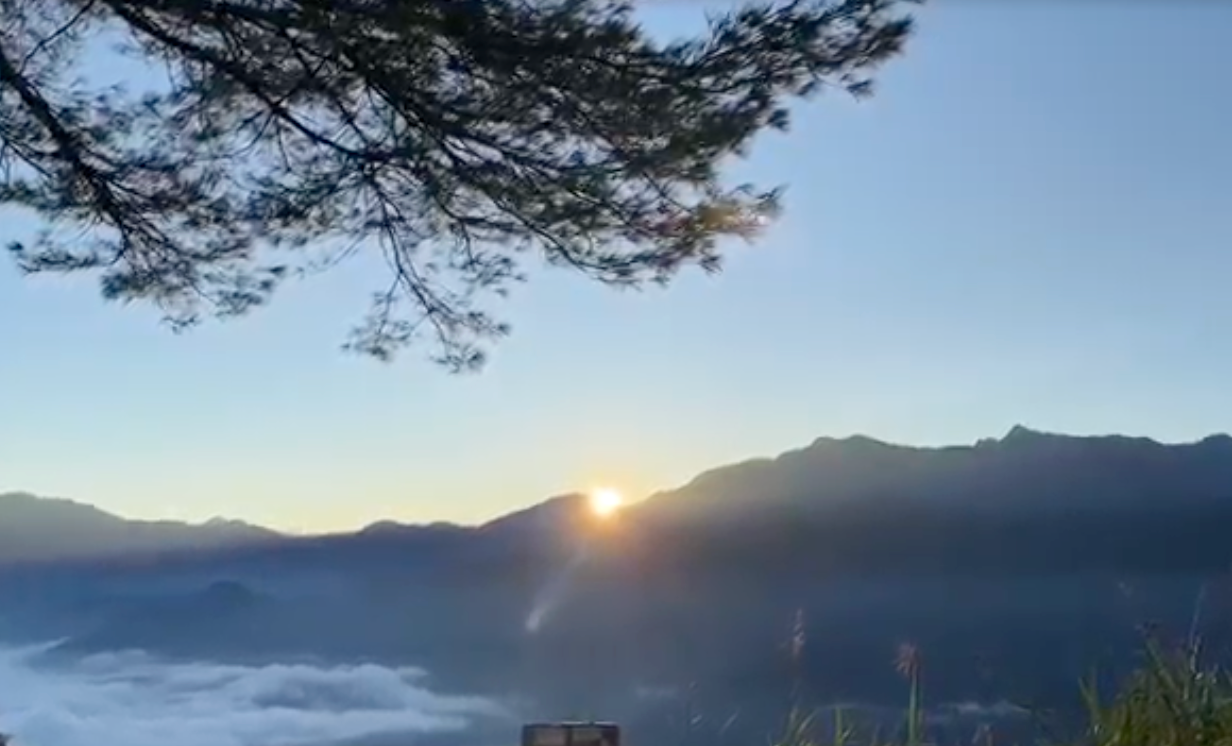
If you ask travelers who have been to Alishan (or are planning to go) to name a sunrise spot, nine out of ten will have heard of Zhushan. But the number who know about Duigaoyue Observation Platform is probably no more than one or two.
Located at 2,467 meters above sea level, Duigaoyue Observation Platform offers the same dramatic sea of clouds at sunrise, and when the morning light breaks across the ridge, the view and sheer impact are arguably even better than at Zhushan. Yet the crowds are far smaller, because it isn’t on the main tourist route. There’s no direct train service and no packed sunrise platform full of people.
If the idea of standing shoulder to shoulder with a thousand other people waiting for the sun to rise doesn’t appeal to you, Duigaoyue may be exactly what you’re looking for. It’s about a one-kilometer walk along a forest path from Zhushan Station, which helps explain why it has become a favorite private spot among photographers who return again and again but rarely publicize it.
Here’s a simple way to decide between the three hidden gems:
| Attraction | Best for | Difficulty | Permit required |
|---|---|---|---|
| Mianyue Line | Experienced hikers, lovers of abandoned-railway vibes | ★★★★ | ✅ Entry permit required |
| Tefuye Historic Trail | Those who love primeval forest and fewer crowds | ★★★ | ❌ No permit required |
| Duigaoyue Observation Platform | Anyone who wants sunrise without the crowds | ★★ | ❌ No permit required |
What’s the best month to visit Alishan? How do the seasons differ?
The best times to visit Alishan are usually from March to April for cherry blossom season and from October to November for autumn foliage.
When planning a trip, many people are drawn in by the spectacular spring cherry blossoms. But the beauty of blossom season also brings huge crowds and strict traffic control measures. That affects not only parking availability but also shuttle schedules. So the “best time to visit” really means finding the right balance between seeing Alishan at its most beautiful and avoiding the worst of the congestion. If you’d rather not spend your trip stuck in traffic, it’s much smarter to avoid peak blossom dates or go on a weekday.
| Season | Months | Main scenery | Crowds | Average mountain temperature | Recommendation |
|---|---|---|---|---|---|
| Spring (cherry blossom season) |
Mar–Apr | 31 varieties of cherry blossoms, including Yoshino cherries | Highest of the year | 12–18°C | ⭐⭐⭐⭐⭐ (A must for blossom lovers) |
| Summer | Jun–Aug | Sea of clouds, firefly season | Moderate | 18–24°C | ⭐⭐⭐⭐ (Great for escaping the heat) |
| Autumn | Sep–Nov | Autumn foliage, sunrise, sea of clouds | Low | 14–20°C | ⭐⭐⭐⭐⭐ (Fewer people, beautiful views) |
| Winter | Dec–Feb | Sea of clouds, sambar deer (at Tataka) | Lowest | 5–12°C | ⭐⭐⭐ (Best for travelers seeking peace and quiet) |
If you’re specifically searching for “what month is best for visiting Alishan attractions,” the answer is actually: all year round.
But if you want to avoid the crowds, enjoy the sea of clouds, and walk pleasant trails, November and December are especially recommended. Autumn foliage season isn’t promoted on the same massive scale as cherry blossom season, so visitor numbers are much lower, parking is easier, and the trails feel much calmer.
That said, you may be wondering: summer often brings afternoon showers, while winter can be very cold, so which month is the safest choice? Honestly, Alishan has a fairly high chance of rain year-round, and in July and August, convective showers in the afternoon happen almost daily. The good news is that they usually clear up later in the day. If you’re trying to minimize the risk of rainy weather, late April and October–November are generally the most stable periods of the year.
What’s the most convenient way to get to Alishan? How much does it cost?
This is probably the transportation question that causes the most indecision for travelers.
In reality, if you’re heading to Alishan from Chiayi, the three main transportation options vary quite a bit in both cost and travel time. Most travelers choose either the Taiwan Tourist Shuttle or a private charter.
| Transportation option | Driving yourself (including parking) | Taiwan Tourist Shuttle 7322 | tripool private charter |
|---|---|---|---|
| Estimated cost (from Chiayi, per person) |
NT$400–600 (fuel + parking) |
NT$484 (round trip) | Around NT$700–900 per person when split among 4 people |
| Travel time (Chiayi → Alishan) |
About 1.5–2 hours | About 2–2.5 hours (including stops) | About 1.5 hours (direct) |
| Luggage handling | You handle it yourself; convenient once you’re driving up | You carry it yourself; luggage space is limited | Driver assistance; stored in the trunk |
| Best suited for | Off-peak seasons, light packers, confident mountain drivers | Solo travelers, budget-conscious visitors | Groups of 3 or more, travelers with luggage, people planning to see sunrise |
From a transportation and budget-planning perspective, Taiwan Tourist Shuttle 7322 is definitely the most affordable way for budget travelers to get to Alishan. A private charter, on the other hand, costs more upfront but offers unbeatable flexibility and comfort for families and larger groups.
That said, there’s one important reminder: whichever option you choose, don’t forget to include the admission fee for the Alishan National Forest Recreation Area in your overall budget. That ticket is what gives you access to the giant sacred trees, Sister Ponds, and the sunrise viewing spots inside the park.
How do you take Taiwan Tourist Shuttle 7322? What’s the timetable?
Taiwan Tourist Shuttle 7322 runs directly from Chiayi Railway Station to Alishan. According to the Taiwan Tourist Shuttle travel service website (as of March 2026):
- Outbound first departure: 06:05 (from Chiayi Railway Station), last departure 14:10
- Return first departure: 09:10 (from Alishan Station), last departure 17:10
- Stops: Chiayi Railway Station → Chukou Visitor Center → Love Prairie → Chukou → Eryanping Trail (Anding) → Xiding → Shizhuo → Fenqihu → Youth Activity Center → Alishan Transfer Station
- Fare: NT$242 one way for adults, NT$484 round trip
However, there’s one detail about Taiwan Tourist Shuttle that people often overlook: some departures include both reserved-seat and non-reserved sections. Before long weekends, it’s best to reserve your seat on the official website in advance. Otherwise, you may show up only to find there are no seats left and spend the whole ride standing on the way up the mountain.
If you’re traveling to Alishan as a group of four, many people actually end up choosing a private charter after doing the math. A round trip on the Taiwan Tourist Shuttle costs NT$484 per person, so for four people, that’s already close to NT$2,000.
Once you add transfers, luggage, and the hassle of queuing early in the morning, a lot of people end up saying, “We should’ve just booked a car.”
👉🏻 Want a more detailed comparison of Alishan transportation options? Including travel time and cost breakdowns from different departure points, you can check out: A Complete Comparison of 7 Ways to Get to Alishan, or go directly to tripool.app and enter your departure point for a free fare estimate.
✅ Best for: direct travel from other counties or cities, late-night departures, travelers looking for the most economical option
❌ Not ideal for: travelers who need flexible stops or are prone to motion sickness on long rides
Is a private car to Alishan expensive? Is it worth it?

Here’s the bottom line: a private charter isn’t a luxury option, it’s simply the option that becomes cost-effective once you have a group. The math is straightforward: the more people you have, the lower the cost per person.
If you’re traveling with 4 or more people, the per-person cost of a private charter is often only about NT$200–400 more than taking the Taiwan Tourist Shuttle. For that difference, you get door-to-door pickup, no need to haul your luggage up and down yourself, much more flexible departure times (no need to worry about the last bus), and the ability to head up the mountain during the day or in the middle of the night.
This is especially useful if you want to see the sunrise but don’t want to stay overnight at one of the pricier mountain hotels. With a pre-dawn private car from your home, you can head straight up to Alishan without having to drive those countless mountain bends yourself in the dark, you can simply rest in the back seat and wake up ready for sunrise.
With tripool’s Alishan private charter service, the entire journey is handled by licensed professional drivers with solid mountain driving experience, using legal vehicles, with transparent pricing and no hidden fees.
If you’re traveling solo or in a small group, there’s also a shared ride option that guarantees departure even for one passenger. No meetup point required, no need to organize your own group, and no worries about last-minute cancellations. Even for women traveling solo, it makes an Alishan trip feel safe, smooth, and stress-free.
👉🏻 For more itinerary ideas and detailed pricing, see: The Complete Guide to a Chiayi–Alishan Private Car Day Trip.
How do you get Alishan little train tickets? Can you still see the sunrise if you don’t get one?
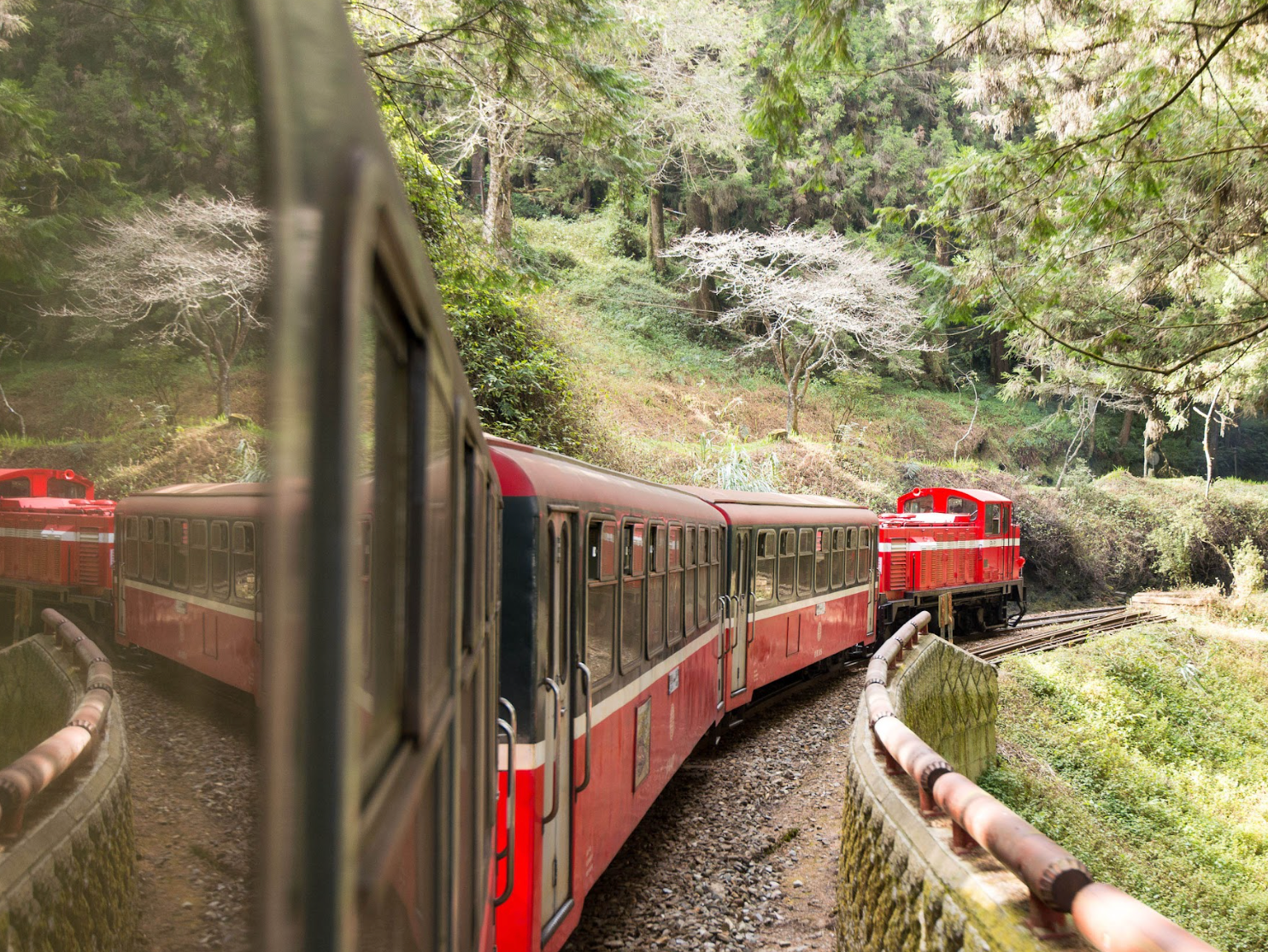
Tickets for the Alishan little train need to be reserved in advance, and they often sell out within 15 minutes of release. But even if you miss out, you can still see the sunrise by walking the Sunrise Trail.
Honestly, trying to get those tickets can feel ridiculous. Anyone who has ever fought for concert tickets will understand the experience.
But missing out on train tickets does not mean missing the sunrise. From Alishan Station, you can walk the Sunrise Trail to Zhushan Observation Deck in about 50–70 minutes. The route is well lit and in good condition, and many travelers say the atmosphere of walking up before dawn is even more memorable than taking the train.
You don’t have to squeeze into a packed train with hundreds of other people. Instead, you can walk at your own pace and feel the cold mountain air around you. That said, our editor still recommends bringing a flashlight and a windproof jacket. Walking uphill will make you sweat, but once you stop and wait for sunrise, those 20 minutes can feel the coldest due to radiative cooling. In that moment, a windproof outer layer matters more than a thick sweater.
👉🏻 For detailed train schedules and ticketing information, see: The Complete 2026 Guide to the Alishan Little Train.
What time should you get to Zhushan Observation Deck for sunrise? Where’s the best viewing spot?
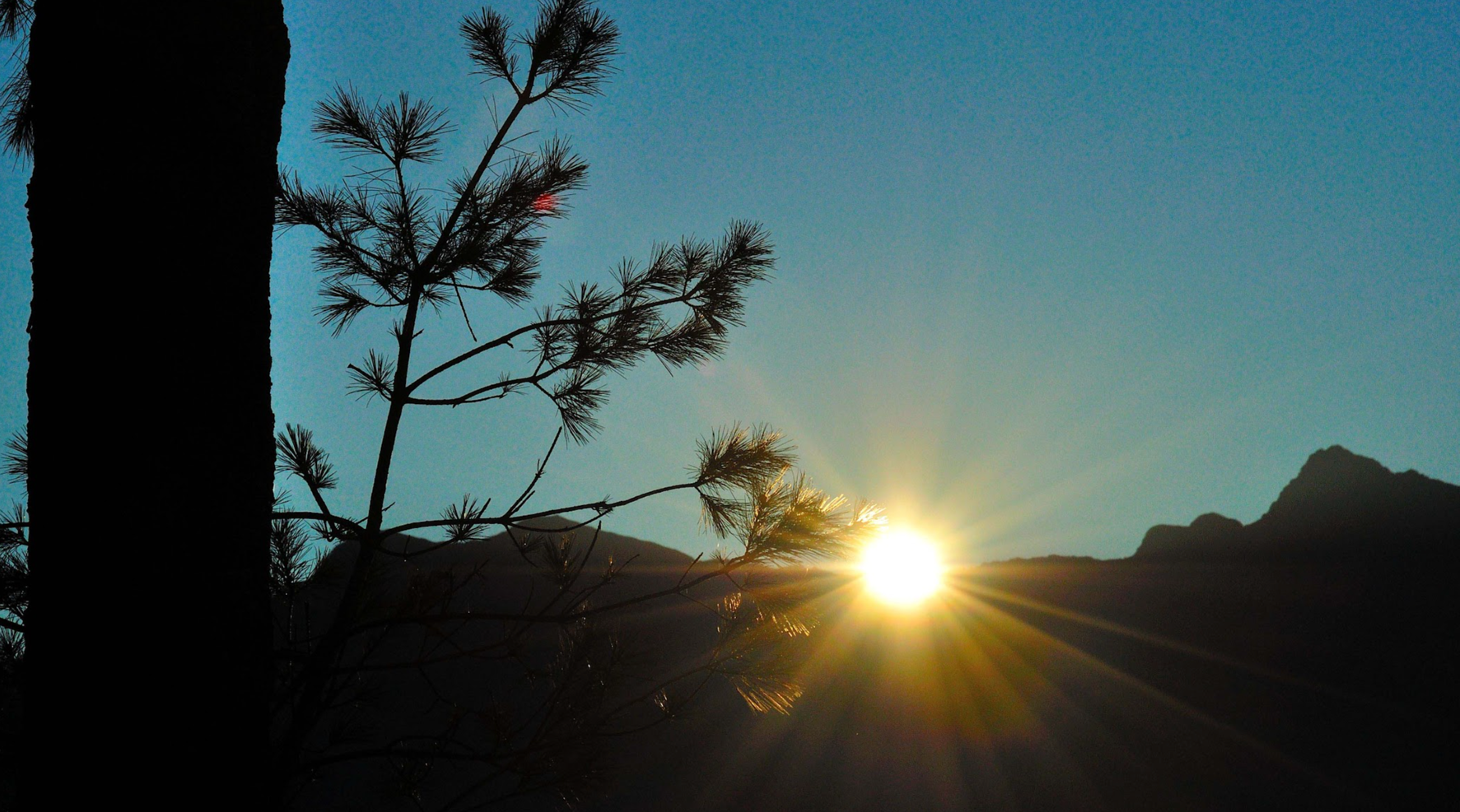
In fact, whether or not you manage to get a train ticket doesn’t really determine whether you’ll see the sunrise, you can always walk.
Two ways to get to Zhushan
- Take the little train: about 15 minutes from Alishan Station, with the first train departing around 04:30–05:00 (depending on the date, so check in advance)
- Walk the Sunrise Trail: about 50–70 minutes on foot from Alishan Station. The path is lit, but bringing a headlamp or flashlight as backup is still a good idea.
Where to stand on the viewing platform
Zhushan Observation Deck sits at 2,489 meters above sea level, and sunrise in March and April is usually around 06:00–06:30. It’s best to arrive 40–60 minutes early so you can choose a spot with a wider view and relatively fewer people. The first time we went, we naively stood in the middle and had the entire sunrise blocked by the people in front. It wasn’t until the second visit that we realized the importance of getting into position early. Arriving just 20 minutes earlier, or even 5 minutes later, can make a huge difference in where you end up standing.
What if it rains or it’s cloudy?
If it rains in Alishan, then yes, you may not see the sunrise. But if it’s cloudy, you may actually get a sea of clouds instead, and that can be even more dramatic than a perfectly clear sunrise. On completely cloudless days, the sunrise is crisp and clear, but without the layered cloudscape, it can feel a little less dynamic. If your fitness allows, you might consider skipping Zhushan Observation Deck altogether and walking an extra 15 minutes to Xiaoliyuanshan Observation Deck, which offers a 360-degree panoramic view (including distant views of Yushan and Xiuguluan Mountain). The visibility there is broader, with fewer obstructions, making it the more premium sunrise option in Alishan.
And if you get lucky with a clear day, with the sea of clouds resting just below the steps and the sun rising over the ridge to the right, there will be a moment when the entire platform suddenly falls silent. That’s when you know the whole sunrise trip was worth it.
Can you do Alishan as a day trip? What itinerary would you recommend?
If your schedule is tight and you only have one day, it’s a good idea to make the Alishan Forest Railway (the little train) part of your itinerary. Riding the train is a scenic experience in itself, and it also gives you the chance to briefly stop at Fenqihu Old Street to try the area’s famous railway lunch boxes and soak up the mountain-town atmosphere before continuing into Alishan. That said, a day trip is limited in time, so it’s better to focus on key highlights like Zhushan or Sister Ponds rather than trying to do every Alishan attraction in one go.
- Only one day → choose a highlights-focused day trip and concentrate on attractions inside the recreation area
- Want to see the sunrise → you’ll need to arrive the previous afternoon and stay overnight on the mountain, or leave Chiayi at 4–5 a.m. (possible, but tiring)
- Traveling with seniors or children → a two-day trip is much more comfortable, with no need to rush between stops
- Want to include both Fenqihu and Danaiku → definitely make it a two-day trip; one day is only enough for the recreation area
Alishan one-day highlights itinerary (best for weekdays outside blossom season)
| Time | Attraction or activity |
|---|---|
| 08:00 | Depart from Chiayi |
| 10:00 | Arrive in Alishan and enter the park |
| 10:30–12:00 | Sister Ponds + Shouzhen Temple area |
| 12:00–13:00 | Lunch inside the park |
| 13:00–14:30 | Giant Tree Boardwalk |
| 14:30–15:30 | Little train experience or free time on the trails |
| 16:00–17:00 | Return to Chiayi |
Alishan two-day full itinerary (including sunrise)
| Time | Attraction or activity |
|---|---|
| Day 1 afternoon | Depart Chiayi → arrive → visit Sister Ponds and the sacred tree area, then have dinner on the mountain |
| Day 1 evening | Stay overnight in Shizhuo or at a guesthouse near the recreation area |
| Day 2 early morning | Depart at 04:30–05:00 → head to Zhushan Observation Deck for sunrise |
| Day 2 morning | Return to the recreation area for breakfast, then head to Fenqihu or Danaiku |
| Day 2 afternoon | Return to downtown Chiayi |
What trails are there in Alishan? How difficult are they, and who are they suitable for?
There are five main trails inside the Alishan National Forest Recreation Area. The shortest, the Sister Ponds loop trail, takes only about 30–40 minutes, while the longest, Tashan Trail, takes about 2.5–3 hours one way. The differences in difficulty are significant, so it’s important to match your choice to your fitness level before setting out.
That’s why weather should absolutely be part of your decision when choosing a trail. Good weather can make all the difference, whether you’re strolling along the magnificent giant tree boardwalk or exploring one of Alishan’s lesser-known hidden spots, such as the Tefuye Historic Trail. Better visibility also means better safety.
On the other hand, after days of heavy rain, routes like Eryanping Trail can become slippery and muddy, and dense fog can dramatically reduce visibility at more remote scenic points. So after rainy weather, it’s best to stick to well-built wooden boardwalks and avoid rougher forest paths whenever possible.
| Trail | Length | Time needed | Difficulty | Highlights | Recommended for |
|---|---|---|---|---|---|
| Sister Ponds loop trail | About 180 meters | 15–20 minutes | ⭐ Easy |
Lake views, photo spots, wooden boardwalk | Everyone, including seniors and young children |
| Giant Tree Boardwalk | About 1.1 km | 45–60 minutes | ⭐⭐ Easy |
Ancient red cypress trees, elevated boardwalk | Everyone |
| Sunrise Trail (to Zhushan) | About 2.5 km | 50–70 minutes | ⭐⭐ Easy to moderate |
Pre-dawn atmosphere, alternative to the little train | Anyone with moderate fitness or above |
| Eryanping Trail | About 2.1 km (one way) | 60 minutes | ⭐⭐⭐ Moderate |
Sea of clouds viewpoint, fewer people | Those with some hiking experience |
| Tashan Trail | About 3.5 km (one way) | 3–5 hours | ⭐⭐⭐⭐ Challenging |
Highest elevation, chance to spot sambar deer | Experienced hikers |
📌 A few quick suggestions:
- If you want an easy route: take the little train to Zhaoping Station → walk to Sister Ponds → continue to Shouzhen Temple → follow the Giant Tree Boardwalk → take the train back from Shenmu Station.
- If you want to visit Eryanping: plan it for your first day on the way up the mountain, arriving around 3–4 p.m. to catch sunset and the sea of clouds, then drive onward to your accommodation afterward.
What should you keep in mind when visiting Alishan with seniors or children?
Alishan sits at about 2,200 meters above sea level, and temperatures are more than 10°C lower than in downtown Chiayi year-round. Even in summer, you’ll need to bring a warm jacket, and if you’re planning to watch the sunrise, it will feel even colder in the early morning. Temperatures on the mountain commonly fall to 8–12°C.
So if you’re choosing attractions for a trip with seniors or children, it’s important to consider not just the weather and clothing, but also their physical limits. Sister Ponds is strongly recommended as a must-visit stop. The loop trail around the ponds is well designed, flat, and easy to walk, which makes it gentler on seniors’ knees and also stroller-friendly for families. Compared with other routes that have more stairs or steeper inclines, this is one of the easiest ways for the whole family to enjoy Alishan’s mountain and lake scenery without overexertion.
Warm clothing checklist
- Light windproof jacket (essential, even in summer)
- Long pants (wearing shorts on the mountain at sunrise is basically asking to suffer)
- Fleece or a thick jacket (essential in winter and early spring)
- Hat (for warmth and wind protection; it gets very windy before dawn)
- Umbrella or lightweight raincoat (short afternoon showers are common in Alishan)
- Sneakers (some trail sections are gravelly; sandals or dress shoes are not recommended)
Weather-checking tips
After going through discussions on Dcard and PTT about alishan taiwan tourist attractions, one mistake comes up more than any other: checking the wrong weather forecast.
It’s best to look up the forecast for “Alishan Weather Station” the day before your trip, rather than relying on the weather in downtown Chiayi. The conditions in the two places can be completely different.
For a more complete seasonal weather breakdown, see: The Complete Guide to Alishan Weather (Seasonal packing tips + rain and sun protection advice).
📌 Quick tip: if the forecast the day before your trip shows that it has already been raining heavily for two straight days, we would recommend rescheduling if possible. Rainy and misty Alishan has its own beauty, but if your main goal is to see cherry blossoms or sunrise, it can be disappointing. The sights aren’t going anywhere, so waiting for better weather is often much more worthwhile than forcing the trip through anyway.
Bonus: When does the 2026 Alishan cherry blossom season begin?
If you’re planning to visit in March or April, there’s one thing you need to check in advanc, if you get it wrong, you may end up being turned back halfway up the mountain.
In 2026, Alishan’s cherry blossom season runs from March 10 to April 10, and the famous Yoshino cherry trees are expected to reach peak bloom in mid to late March.
This year’s blossom season is especially notable for its variety, with as many as 31 types of cherry blossoms blooming one after another. They flower progressively from lower to higher elevations, extending the overall viewing period to nearly four weeks. That said, blossom season is also the busiest period of the entire year, so if you’re planning to go up on a weekend, traffic restrictions are one of the most important things to check before you leave.
Are there traffic restrictions during blossom season? On which dates, and at what times?
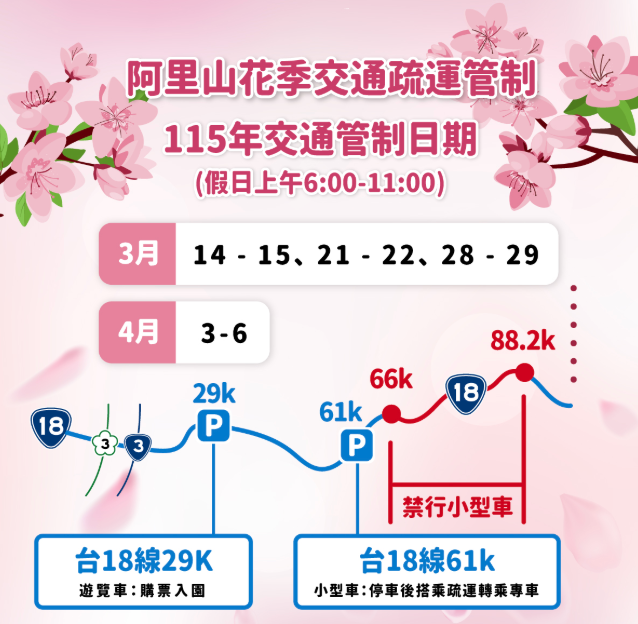
Image source: Forestry and Nature Conservation Agency, Ministry of Agriculture (Chiayi Branch)
Knowing the blossom season dates isn’t enough. During traffic control periods, private vehicles can’t simply drive up the mountain.
During the 2026 Alishan cherry blossom season, private vehicle traffic control will be enforced on 9 days. Every day from 06:00 to 11:00, general private cars will be prohibited from entering from Provincial Highway 18 at 66K onward. Guests with proof of accommodation may pass through; all other visitors will need to switch to the Taiwan Tourist Shuttle or a private charter.
According to the Alishan National Scenic Area Administration (as of March 2026), traffic control will be enforced on Provincial Highway 18 from 66K to 88.2K on the following dates:
| Control dates | Control hours | Restricted section | Exceptions |
|---|---|---|---|
| March 14 (Sat), 15 (Sun) | 06:00–11:00 | Provincial Highway 18, 66K–88.2K | Guests with proof of accommodation may pass |
| March 21 (Sat), 22 (Sun) | |||
| March 28 (Sat), 29 (Sun) | |||
| April 3 (Fri) to 6 (Mon) (Tomb Sweeping holiday) |
⚠️ Blossom season traffic reminder: if you’re planning to drive yourself up the mountain, you’ll still need to switch to the shuttle transfer service at the 61K Leye Service Area on Alishan Highway during the 06:00–11:00 control period in order to reach the Alishan Forest Recreation Area. Even after private cars are allowed through again after 11:00, parking remains extremely limited during blossom season and holiday periods. Based on feedback from many travelers, it can still take more than an hour just to find a parking spot, meaning you may end up spending more time in the parking lot than at the attraction itself.
👉🏻 If you’re hoping to catch the Yoshino cherries at their peak, the ideal window is roughly between March 15 and March 25, when the probability of full bloom is highest.
How much are tickets for Alishan attractions?
Admission to the Alishan National Forest Recreation Area is NT$300 for non-Taiwanese nationals and NT$200 for Taiwanese nationals. Children aged 7 to 13 pay NT$150, while children aged 3 to 6 and seniors aged 65 and above pay NT$10.
Estimated cost for a family of four (excluding transportation)
| Item | Estimated cost |
|---|---|
| 2 adult tickets | NT$400 |
| 2 child tickets (ages 7–13) | NT$300 |
| Lunch (4 people) | NT$500–800 |
| Little train experience (4 people, depending on ticket availability) | NT$400–600 |
| Total (excluding transportation) | NT$1,600–2,100 |
At NT$200, admission is quite reasonable because it includes Sister Ponds, the sacred tree area, the Giant Tree Boardwalk, Zhushan Observation Deck (for sunrise), and all of the main trails. The only extra cost to factor in is the little train ticket, which is charged separately.
If you’re traveling with a group of four or more, it’s worth calculating the round-trip cost of a private charter in advance. Sometimes the difference compared with the Taiwan Tourist Shuttle is smaller than people expect. You can enter your departure point for a free private-car fare estimate and then decide once you’ve confirmed vehicle availability for your dates.
Frequently asked questions about Alishan attractions
Q: How long does it take to see Alishan?
Visiting the main attractions in the Alishan recreation area, such as Sister Ponds and the Giant Tree Boardwalk, takes about 2–3 hours. If you add the Zhushan sunrise itinerary, you’ll need around 5–6 hours in total, including the early-morning departure.
If you only do the Sister Ponds loop trail, though, it can be completed in just 20–30 minutes.
But if you want to cover all of the main trails in one go, including Eryanping and the Sunrise Trail, and factor in transportation, then you’ll likely need a full day. It’s best to identify your priority attractions before you go and estimate your time accordingly, rather than exhausting yourself by trying to see absolutely everything.
Q: Is Fenqihu worth a separate trip when visiting Alishan?
Fenqihu is definitely worth visiting, but it’s not ideal to squeeze both Alishan and Fenqihu into a single day. It’s better planned for the second day of a two-day trip, or as its own half-day outing.
The main appeal of Fenqihu is its old street atmosphere and its famous railway lunch boxes (NT$120–150). The railway scenery also adds a lot of charm. Browsing the old street and having lunch there takes about 1.5–2 hours, which is just right.
Since Fenqihu is further downhill from the Alishan recreation area, adding it to a one-day trip means more travel time, and in the end you may only rush through both places without really enjoying either.
Q: How do you get to Danaiku in Alishan, and how much is admission?
Danaiku Nature Ecological Park is located in Shanmei Village (a Tsou Indigenous village), outside the main recreation area. You’ll need to travel there separately from either Chiayi or Alishan, and adult admission is NT$150.
Q: What other attractions in downtown Chiayi can be added to the trip?
If you’re planning an Alishan itinerary from Chiayi, you can also pair it with downtown Chiayi attractions such as Wenhua Road Night Market, Hinoki Village, and Chiayi Park. These are all good options for the day before, so you can explore the city first and head up to Alishan the following morning.
In fact, this is exactly how many travelers plan it: arrive in downtown Chiayi the afternoon before, have dinner at Wenhua Road Night Market, and then set off for Alishan early the next morning.
And beyond the recreation area itself, attractions along Provincial Highway 18, such as Shizhuo coffee farms and the Xiding Sea of Clouds Viewing Platform, are also worth a stop on the way up from Chiayi, without needing to make a major detour.
tripool editor’s honest take: this is the best way to do Alishan
Honestly, if you only have one day, our editor would prioritize the four highlights inside the recreation area: Zhushan, Sister Ponds, the sacred tree area, and the little train experience. Save Fenqihu and Danaiku for a two-day trip.
If you try to cram every single attraction into one day, the experience is exhausting unless you’re using a private charter service that takes you directly from point A to point B and saves you the hassle of transfers. Otherwise, most of the trip ends up feeling like you’re just “passing through” each place.
And choosing a few places outside the standard tourist circuit can make the whole trip feel more rewarding. The first time we visited Xiaoliyuanshan Observation Deck, there were no expectations at all. The sea of clouds happened to be sitting just below the steps, with four or five peaks rising up out of the white, and the sun coming in at an angle from the right. There was also an older man standing nearby, quietly watching the view for a long time. That kind of still, powerful moment is not something you usually get at ordinary tourist attractions. To this day, it remains one of our favorite hidden spots in Alishan. So next time you visit, don’t just stay within the main Alishan park area, venture out to some of the lesser-known scenic spots around the edges as well.